
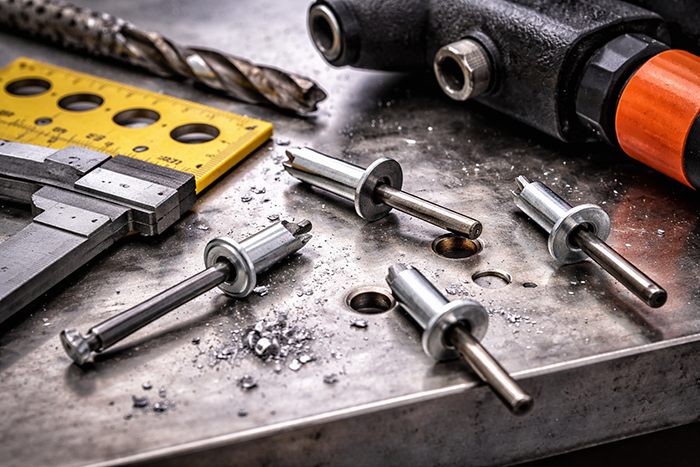
The blind rivet is one of those components that ‘always work’… until mandrels start pulling out completely, heads fail to clamp properly, or joints loosen at the first sign of stress. In almost every case, the root cause lies in a mismatch between thicknesses, hole dimensions, and incorrectly selected accessories.
The most common mistakes are:
· Using the rivet on thicknesses below the specified range: the rivet body does not have enough material to grip, and the mandrel may pull completely through the sleeve.
· Oversized or burred holes: the rivet cannot properly ‘bite’ into the material, and the mandrel may partially or fully pull out.
· Thicknesses exceeding the rivet’s grip range: the mandrel does not break at the correct point, resulting in incomplete clamping.
· Incorrect nosepiece selection: if the diameter is not suitable, the mandrel is not properly retained and guided.
· Materials that are too soft or unsuitable plastics: the mandrel tends to pull out, as the rivet body expansion does not encounter sufficient resistance.
The key is to select the rivet according to the total thickness, the materials being joined, and the actual hole diameter, always checking the grip range indicated in the technical data sheets. A simple hole gauge and a rivet-to-drill-size reference chart can eliminate many recurring issues.