
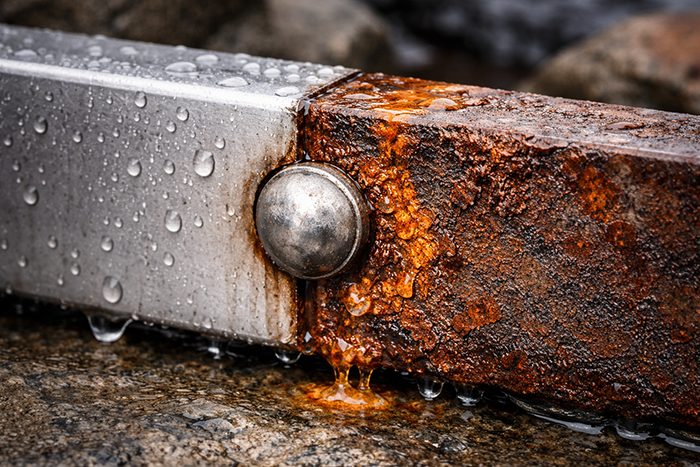
When two different metals come into contact in the presence of moisture or water, a frequently underestimated phenomenon can occur: galvanic corrosion. It is the same principle as a battery, but applied to your joint — one of the metals becomes the anode and corrodes more rapidly, protecting the more noble metal.
To reduce the problem, it is good practice to:**
• Use metal pairings that are as similar as possible or close in galvanic potential.
• Apply coatings or insulating materials to prevent direct contact between surfaces.
• Avoid geometries that promote water or moisture stagnation around the fastening.
Selecting the correct material combination at the design stage is far more effective than any corrective action taken later.