
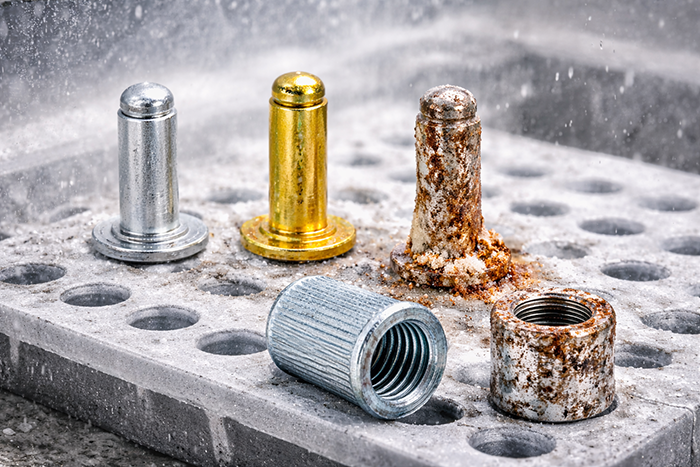
Beyond the galvanic component, fasteners are also exposed to chemical corrosion caused by environmental conditions: oxygen, pollutants, chemicals, or aggressive vapours can directly attack the metal. The resistance of a rivet or threaded insert depends not only on the base material, but also on the surface treatment that protects it.
In recent years, there has been a gradual elimination of heavy metals and harmful coatings — such as lead, mercury, cadmium, PBB/PBDE, and hexavalent chromium — in line with major European environmental and safety directives (such as RoHS, REACH, and ELV). This shift has led to the adoption of safer zinc coatings and surface treatments capable of providing effective protection without critical impacts on health and the environment.
Corrosion resistance performance is often evaluated through salt spray testing, which is useful for comparative purposes but does not perfectly replicate real service conditions. For demanding applications, it is advisable to compare laboratory test conditions with the actual operating environment, avoiding use beyond material limits — for example, applying zinc-coated components at temperatures above 250 °C, where the coating may lose effectiveness.